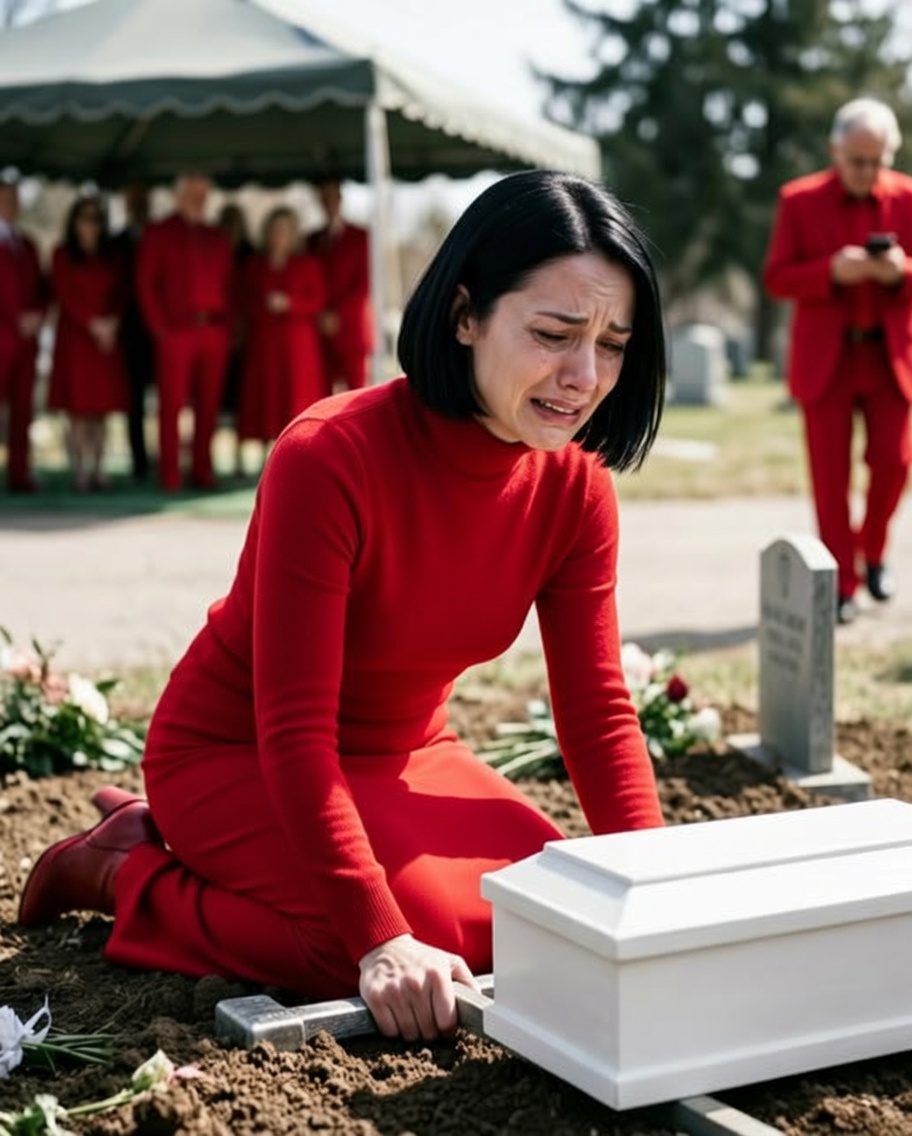
My parents chose my brother’s barbecue over my baby’s funeral and told me, “It’s just a baby. You’ll have another.” I buried my daughter by myself, and what I did afterward changed everything.
My mother said, “It’s just a baby. You’ll have another,” less than an hour before I laid my daughter to rest.
Even now, writing that sentence feels unreal—like something too cruel to belong to ordinary life. But it happened exactly there, in ordinary life: on a bright Saturday morning in Columbus, Ohio, as I stood in a black dress outside a small funeral home holding a folded blanket that still carried the faint scent of baby soap.
My daughter’s name was Lily.
She lived for twenty-three days.
Twenty-three days of hospital monitors, whispered prayers, nurses adjusting tubes, and me learning how to love someone with a fear so constant it never let me sleep. She was born with a severe heart defect no one had detected early enough. By the time the doctors fully explained the surgeries she would need, their words already sounded like grief disguised as hope. I stayed with her every moment I was allowed. I memorized the shape of her hands, the curve of her eyelashes, the small sound she made when she settled against my chest. Then one Tuesday night at 2:14 a.m., as rain tapped softly against the NICU windows, she was gone.
The funeral was four days later.
I called my parents myself. Not because I wanted to, but because some part of me still believed blood should matter when everything else had fallen apart. My father answered first, distracted, then passed the phone to my mother. I told her the service was at eleven. I told her I needed them there. I told her I didn’t think I could do it alone.
There was a pause, then laughter and voices in the background.
“Today?” she asked.
“Yes, today.”
Another pause. Then, in the same tone she might have used to talk about the weather, she said, “Your brother already invited people over for the barbecue. We bought all the food. We can’t just cancel on everybody.”
I thought I had heard her wrong.
“Mom,” I said, “I’m burying my daughter.”
She exhaled sharply. “Madeline, I know you’re emotional, but it’s just a baby. You’ll have another. Your brother’s event has forty people coming.”
Forty people.
I looked through the glass doors of the funeral home and saw a tiny white casket waiting at the front of the chapel. My knees actually weakened. Not just from grief—from realization. Grief tells you what you’ve lost. Betrayal tells you what you never truly had.
My father came back on the line, muttered something about traffic, obligations, trying to “keep peace,” and then the call ended.
So I walked into that room alone.
No parents. No brother. No family behind me when the minister asked if anyone wanted to speak. Just me, my shaking hands, and a room full of flowers that felt too bright for death. I stood beside my daughter’s casket and somehow found words for a life that had barely begun.
When it ended, I didn’t collapse.
I drove home alone, still dressed in black, still hearing my mother’s voice in my head. It’s just a baby.
That was the moment something inside me hardened.
By sunset, I had made three phone calls, opened a locked file I had kept for years, and set in motion a chain of events my family would never undo.
The first call I made after the funeral wasn’t to a friend, a therapist, or even Lily’s father, who had disappeared during my pregnancy and perfected the art of apologizing from a distance.
I called my attorney.
Her name was Rebecca Sloan, and she had handled my grandmother’s estate two years earlier. My grandmother, Eleanor Wade, was the only person in my family who ever saw my parents clearly. She used to say my mother confused appearances with values, and my father treated cowardice like diplomacy. When she died, she left most of her estate to me—not because I was the favorite, but because I was the only one she trusted not to waste it or turn it into a weapon.
That inheritance quietly changed my life. I used part of it to buy my home outright. I invested the rest. What my parents didn’t know—or chose to forget—was that my brother Nolan’s landscaping company had survived its first bad year because I covered a private debt through a family trust my grandmother had created. My father’s second mortgage crisis had eased because I paid off a tax lien in exchange for temporary control over part of the family lake property. I had done all of this quietly, without humiliation, because I believed family duty meant helping people who would never say thank you.
The second call I made that afternoon was to the property records office.
The third was to the bank managing the trust.
By evening, grief had sharpened into a kind of clear, dangerous focus.
Rebecca met me at my house at seven-thirty. I was still in the funeral dress, mascara dried beneath my eyes, Lily’s hospital bracelet wrapped twice around my wrist because I hadn’t yet found the strength to remove it. She sat across from me at the kitchen table while I laid out papers I hadn’t looked at in months.
“I don’t want revenge,” I said.
Rebecca held my gaze. “That’s not true.”
I looked down at the documents. “Fine. I want consequences.”
That was the right word.
Because what my parents had done wasn’t one cruel sentence on one terrible day. The funeral simply stripped away the excuses. The truth was older. Nolan had always been the center of the family’s orbit. When he dropped out of college twice, he was “finding himself.” When I worked double shifts in nursing school and missed Thanksgiving, I was “too career-focused.” When I got pregnant and chose to raise Lily on my own, my mother called it selfish before she ever called it brave. Everything in our family bent toward Nolan’s comfort and my parents’ image of themselves as loyal, generous people. My grief had simply collided with those priorities—and lost.
Rebecca reviewed the trust documents in silence.
Then she said, “You know you have legal grounds to stop subsidizing all of this immediately.”
I nodded. “Do it.”
Within forty-eight hours, the discretionary payments keeping Nolan’s company afloat were frozen. The repayment schedule on my father’s tax-lien agreement accelerated under terms he had never bothered to read carefully because he assumed I would never enforce them. My attorney drafted formal notices—calm, precise, not emotional, not dramatic. Just legally final.
The response was immediate.
My mother called first, screaming so loudly I had to hold the phone away from my ear. She said I was unstable, vindictive, consumed by grief. She said no decent daughter would punish her family over “one misunderstanding.” Then my father called, quieter and colder, asking if I had lost my mind.
Nolan came to my house that night.
I opened the door to find him on my porch, smelling of smoke and beer, still wearing the same red polo he had probably grilled in the day I buried Lily. He looked angry in the casual way of someone used to being forgiven before offering an apology.
“Mom says you’re trying to ruin us,” he said.
I almost laughed.
“You had a barbecue during your niece’s funeral.”
His jaw tightened. “I didn’t know it was that bad.”
That sentence hit harder than shouting ever could.
“You didn’t know?” I asked. “You knew enough not to come.”
He looked away first. “Mom said you wanted space.”
Of course she did.
There it was again—the machinery of my family. Minimize. Redirect. Protect the son. Recast the daughter as dramatic. Even now, standing in my doorway with my daughter’s death between us like an open grave, Nolan still wanted to negotiate feelings instead of facing facts.
I stepped aside and pointed toward the living room. On the mantel was Lily’s framed hospital photo. Ten fingers. Sleepy eyes. Pink knit cap.
“She was real,” I said quietly. “Not a concept. Not a future baby. Not a replaceable event. Real.”
For the first time, he looked shaken.
“I’m not doing this anymore,” I said. “Not the rescuing. Not the silence. Not the role where I lose and everyone else calls it family.”
He tried to speak, but I closed the door before he could.
Three days later, my mother went to her doctor with stress-related chest pain.
Suddenly, the woman who said I would “have another” wanted everyone to care deeply about one frightened body in pain.
Her condition wasn’t fatal.
That mattered, but it didn’t erase the irony.
The doctor said it was severe anxiety with elevated blood pressure, worsened by panic, exhaustion, and what he politely called “acute family distress.” My father left me a voicemail filled with accusation, as if my refusal to absorb cruelty had somehow turned into a medical crisis I was responsible for fixing.
I didn’t call back that day.
Instead, I went to the cemetery.
Lily’s grave sat in a small section near the back, beneath a maple tree just beginning to turn gold. I brought white roses and sat on the damp grass, talking to her the way I had in the NICU when the nights were long and machines never stopped humming. I told her about the silence in the house. About how people reveal themselves most clearly when you stop making excuses for them. About how sorry I was that the world she entered had already been crowded with selfishness. Mostly, I told her I loved her, because love was the one thing that still felt clean.
When I got home, there were twelve missed calls.
Two from my father. Five from my mother. Three from Nolan. Two from relatives who had ignored me during the funeral and now wanted to “keep the peace.”
That’s how I knew my mother had started telling her version of the story.
By the weekend, an aunt told me my parents were saying I had “spiraled” after losing the baby and was attacking them financially without reason. An uncle said grief shouldn’t turn into vengeance. A cousin texted that my mother was “seeing specialists” and needed support, as if support only flowed toward the loudest person in the room.
So I did something my family never expected.
I told the truth before they could bury it.
Rebecca advised me not to post anything reckless, so I didn’t. I wrote one calm, factual email and sent it to every relative involved. No insults. No threats. Just dates, documents, and exact words. I explained that my parents and brother had skipped Lily’s funeral for Nolan’s barbecue. I quoted my mother exactly: It’s just a baby. You’ll have another. I attached proof of the financial support I had quietly provided for years. Then I ended with one sentence:
I will no longer fund or protect people who abandoned me while I buried my daughter alone.
The silence that followed felt almost sacred.
Then the calls changed.
Not all of them. Some doubled down—there are always people who would rather defend cruelty than admit they benefited from ignoring it. But others called in tears. My aunt Ruth apologized for not checking on me. A cousin sent flowers to Lily’s grave. Nolan’s wife, Claire, admitted she had questioned why no one was leaving for the funeral and my mother had snapped at her to stay out of it. That mattered—not because it fixed anything, but because it confirmed I hadn’t imagined the depth of the betrayal.
My father came to see me the following Tuesday.
He looked older. Not fragile—just stripped of the authority he once wore like armor. He sat in my living room, looked at Lily’s photo, and cried before speaking. I hadn’t seen him cry since his own mother died.
“I failed you,” he said.
I didn’t respond.
He admitted he knew the funeral mattered more than the barbecue. He admitted he let my mother decide because keeping peace with her had become his greatest habit. He admitted he relied on me for years because I was dependable and easier to disappoint than Nolan was to confront.
That honesty cost him something. I could see it.
But honesty isn’t repair.
When my mother finally came—two weeks later, pale, furious, humiliated that relatives now knew what she had said—she didn’t start with an apology. She started with defense. She said she had been “trying to keep the family together.” She said people say the wrong thing under pressure. She said I was punishing everyone permanently for one terrible day.
I stood by the window and looked at her.
“No,” I said. “I am responding to a lifetime that one awful day exposed.”
She began crying then. Loudly. Not because she suddenly understood Lily—but because consequences had entered her life and she couldn’t charm them away. For a moment, I saw her clearly: a woman terrified that the story she told about herself—a devoted mother, a loving grandmother, the center of a close family—had cracked open in public.
I didn’t comfort her.
Months later, the payments remained frozen. Nolan sold part of his business. My father refinanced the lake property under harsher terms. My mother stopped speaking to relatives who refused to defend her. The family didn’t collapse in one dramatic moment. It shifted—quietly, permanently. Roles changed. Illusions disappeared.
People think revenge is loud.
Sometimes it’s a document, a boundary, a refusal—a truth finally spoken without apology.
My parents skipped my baby’s funeral for my brother’s barbecue and told me I would have another.
What they didn’t understand was that after I buried my daughter alone, I also buried the version of myself that had spent years keeping their lives comfortable at the cost of my own pain.
And that woman was never coming back.