He stood on her porch with a worn leather bag and a claim that unraveled everything she thought she knew about her family. By nightfall, the truth inside that bag would fracture her past and rewrite her future. But was he really her brother or a stranger with a story too precise to ignore?
I’ve always been an only child.
At least, that’s what I was told. My parents never mentioned anyone else. It was always just the three of us growing up in a quiet house where questions weren’t always welcome.
After they passed, I spent weeks sorting through their things. Documents, photos, old letters tucked into shoeboxes and desk drawers. But I didn’t find anything unusual. There were no surprises folded between the pages of old birthday cards or hidden inside coat pockets.
Grief had settled into something manageable by then, a dull ache rather than a sharp, breathtaking pain. I had my routines back and had convinced myself that the hardest part was behind me.
I was in the kitchen, halfway through my second cup of coffee, still in my pajamas at ten in the morning because it was my day off and I had earned it.
The house was quiet before there was a knock at the door. It wasn’t an urgent or aggressive one. Just three patient knocks that somehow felt strange.
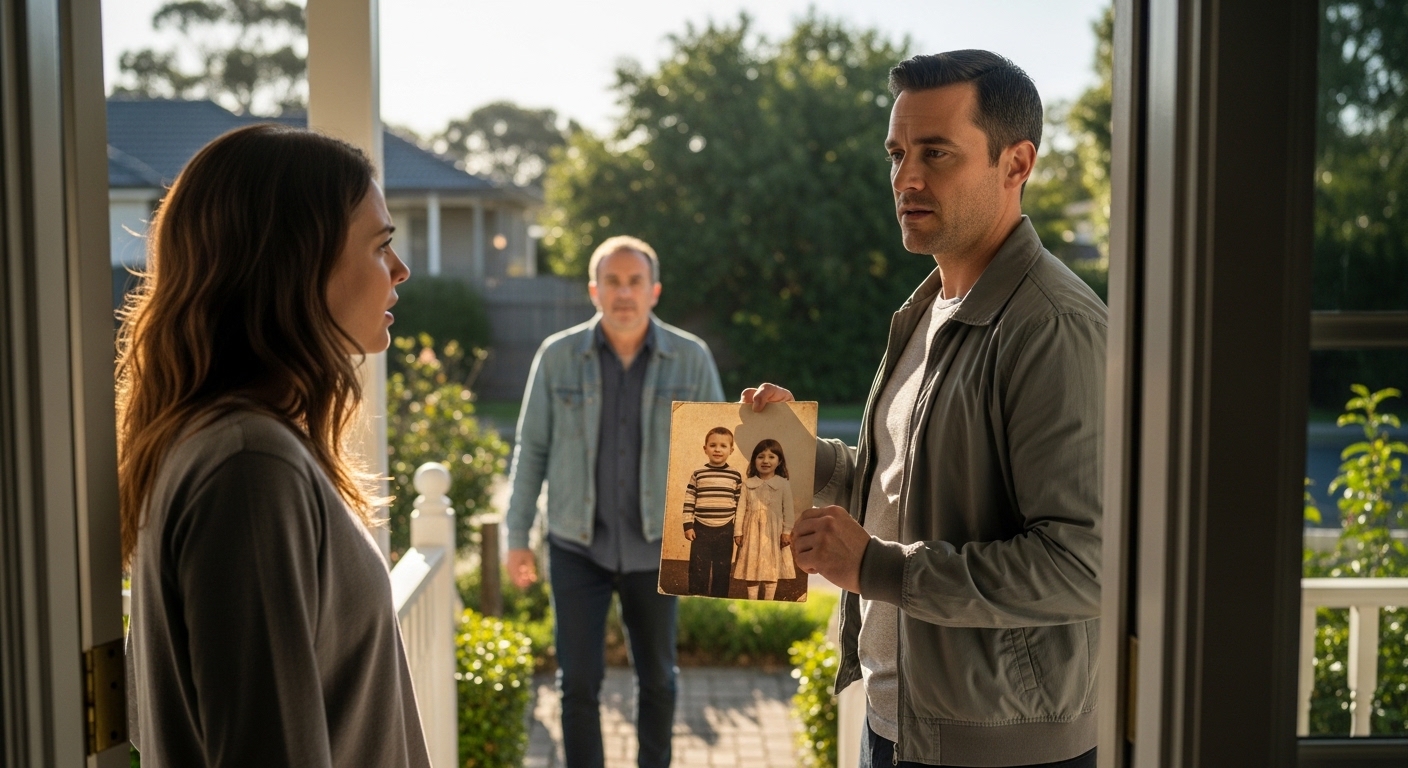
I opened it to find a man standing on my porch. He was in his early 40s with tired eyes that had clearly seen a few too many sleepless nights.
He was dressed simply in a dark jacket and a plain shirt. There was nothing remarkable about him at first glance except for the way he held himself.
There was something about his face that made my stomach tighten before my brain could even begin to catch up. There was a familiarity I couldn’t immediately place.
“Hi,” he said. “This is going to sound crazy, but I’m your brother.”
I actually laughed. It burst out of me before I could stop it.
“You do,” he replied, calm and steady. “You just weren’t told.”
I moved to close the door. My hand was already on the frame, already pushing. But something stopped me.
I guess it was the angle of his jaw and the way it mirrored something I had seen in old photographs of my father as a young man.
I stood there, hand frozen on the door frame, staring at a stranger who didn’t feel entirely like a stranger.
“Please,” he began.
I stepped back, and I don’t really know why.
Some part of me that operates below logic decided that before the rest of me could argue with it. He walked inside slowly and placed an old, worn canvas bag on my kitchen table with the quiet relief of someone setting down something they had been carrying for a very long time.
“Dad asked me to give this to you,” he said. “You’ll understand everything once you open it.”
Inside, there were old photographs, slightly yellowed at the edges.
In those photos, my father, Roland, was holding a baby I had never seen before. Then there were letters, dozens of them, written in his unmistakable handwriting across 40 years of folded paper. Some financial records pointed toward consistent transfers over decades to an address I didn’t recognize.
And at the very bottom of the bag was a sealed envelope with my name written on the front.
At that point, I sat down without meaning to.
The letter was honest in a way my father had never quite managed to be out loud. Adrian — the man now sitting across from me at my own kitchen table — was his son. He was born before his marriage to my mother, Celeste.
She had known. She had always known.
But she had refused, firmly and finally, to raise another woman’s child under her roof. And my father, conflict-avoidant down to his very bones, had chosen silence to hold the family together. He had supported Adrian quietly, from a careful and painful distance, for over 40 years.
“I’m not here for money,” he said, before I could find any words at all. “I just didn’t want to be erased anymore.”
That sentence landed somewhere deep and unexpected. I sat there with my father’s letter in my hands, my entire understanding of my childhood tilting slowly sideways, and I understood with a cold, sinking certainty that this was real.
Every single thing I thought I had known about my family had just become a great deal more complicated.
“Tell me about your life,” I said.
He was 44 years old. He had grown up with his mother, Mirela — a strong-willed, fiercely devoted woman who had raised him entirely on her own and made absolutely certain he never felt unwanted, even when the circumstances of his birth gave him every reason to.
He had seen Roland occasionally throughout his childhood on birthdays and holidays. But their meetings were always brief.
“He asked you to keep the secret,” I said.
“He did,” Adrian replied.
I thought about my father then, and all the times he had been “away on business.” That phrase had drifted through my entire childhood without ever snagging on anything. I had never questioned it.
Then I thought about my mother and the way she could make an entire room feel ten degrees colder simply by going quiet.
I excused myself and stepped into the hallway to call my friend, Tamsin. She picked up on the second ring, the way she always does.
“There is a man sitting in my kitchen,” I said, keeping my voice low and steady. “He says he’s my brother.”
“Okay,” she said slowly. “And?”
There was a brief pause. Then Tamsin said, “So what exactly is the problem? Are you angry because he exists, or because you weren’t told?”
I didn’t answer right away. She let the silence sit there between us, because she knows me well enough to know I sometimes need a moment to catch up with myself.
“Both,” I finally said.
“Fair enough,” she replied. “But those are two very different kinds of anger, Elise. Don’t go mixing them together.”
I went back to the kitchen.
Adrian was sitting exactly where I had left him, patient and completely still, his hands folded on the table like a man who had learned long ago that waiting was simply part of his life.
Then he said something I wasn’t at all prepared for.
“I was at your graduation,” he said quietly. “I was at the back of the auditorium. I stood there the whole time. Dad used to show me pictures of you on every birthday, every school event, and every milestone. I knew your name long before I ever knew what your face looked like.”
I stared at him. I wasn’t sure what to say.
“Dad… he… he brought you to my graduation?” I asked slowly.
“He wanted me to see you,” Adrian said. “I think it was the closest he could get to introducing us without actually having to do it.”
At that point, my anger started to change into something else. It didn’t exactly disappear, but it lost some of its clean, sharp edges.
Because sitting across from this man, I began to understand something I hadn’t been willing to see before. He hadn’t shown up to take anything from me. He had waited his entire adult life for this.
He had been handed a secret as a young child and had carried it obediently and quietly all the way into middle age. He had lost things too — a father who was never fully his, a sister he was never allowed to know, a whole relationship that had been decided against before he was old enough to have any say in it.
He hadn’t intruded on my life.
He had simply, finally, stopped disappearing from it.
I picked up Dad’s letter again after Adrian went quiet. I read it a second time, more slowly. My father had simply written that he had been a coward.
He said he had loved both of his children with equal fierceness. He admitted that he had told himself for decades that the silence was protecting everyone, when the truth was that it had really only ever protected him.
He wrote that he hoped someday, somehow, we might choose each other — even though he had completely failed to give us that chance while he was still alive to see it.
I set the letter down carefully on the table.
The choice sitting in front of me felt both enormous and startlingly simple at the same time. I could hold onto the version of my parents I had always known. I could protect that. I could close the door, literally and figuratively, and keep my memories exactly as they were.
Or I could accept a messier, harder, more complicated truth. That my father had loved me and lied to me in the very same breath. That my mother had known everything and said absolutely nothing.
I looked at Adrian.
He was watching me carefully, quietly, giving me every bit of space I needed to land wherever I was going to land.
“You said Mirela raised you,” I said. “What was she like?”
Something in his face softened immediately, and for just a moment, those tired eyes looked a little less tired.
“Stubborn,” he said, with a small, worn smile. “Genuinely hilarious when she wanted to be. She made the best food I have ever eaten in my entire life, and she had a strict rule that you were not allowed to feel sorry for yourself for more than 24 hours at a stretch.”
“She sounds like someone worth knowing,” I smiled.
“She really was,” he said softly.
I got up and put the kettle on. It was a small thing, a quiet gesture, but he noticed it. I could tell by the way his shoulders dropped just slightly, the tension leaving them like air from a tire.
While the water heated, I asked him about his life now. He told me that he had a 16-year-old son who was completely obsessed with basketball and blissfully unaware that his father was sitting in a stranger’s kitchen having the most significant conversation of his life.
Then, he reached into his jacket pocket and pulled out his phone, turning it toward me.
“This is him,” he said.
When I looked at the screen, a teenager grinned back at me — tall, bright-eyed, with my father’s unmistakable eyes sitting right there in a 16-year-old’s face.
“I have a nephew,” I said out loud. Mostly because I needed to hear how those words actually sounded coming out of my mouth.
We sat at that kitchen table for another two hours.
We didn’t solve everything or wrap it up neatly or declare ourselves a family and simply move forward. There were still questions I didn’t have answers to, feelings I hadn’t finished working through, and old memories that were going to need re-examining in a light I hadn’t asked for.
But we talked about Dad, about our childhoods, and the strange parallel lives we had been living just miles apart.
When Adrian finally stood to leave, he paused at my front door.
“Thank you,” he said quietly. “For not closing it.”
“I almost did,” I told him honestly.
“I know,” he said. “But you didn’t.”
I watched him walk to his car, and I stood in the doorway for a long moment after he had gone, the evening air cool against my face, the street completely ordinary around me.
I grew up an only child, I told myself. But I won’t get to stay one.
If a stranger knocked on your door tomorrow with proof that your family wasn’t exactly who you thought they were — would you let them in?
If you enjoyed reading this story, here’s another one you might like: Victoria thought buying her first home meant she’d finally made it. But on moving day, her nine-year-old son refused to step inside — and pointed at the basement door. What was hiding behind it?