The intersection of human compassion and cosmic timing often manifests in the most unassuming places. For many, this exists only in the abstract, but for me, it materialized on a grease-slicked sidewalk outside a late-night takeaway window on a night so cold the air felt like shattering glass. I was coming off an exhausting double shift, my mind occupied by rising utility bills and the unreliability of public transit. I was the typical urban commuter, head down and collar up, until I saw her—a teenage girl named Isla, huddled against the brickwork like a discarded shadow.
She was seventeen, visibly pregnant, and dressed in a thin hoodie that offered no defense against the biting wind. Her shoes were worn to the soles, a stark visual of the systemic challenges of poverty that most people choose to ignore. When she asked for help buying a bowl of soup, her voice wasn’t the pitch of a grifter; it was the hollow rasp of someone at the end of her endurance.
Despite my own exhaustion, I ushered her into the heat of the shop—a sanctuary in a brutal winter. I ordered her a feast: hot vegetable soup, a mountain of chips, and a decadent hot chocolate. While we waited, I handed her my own coat. As she ate, Isla shared fragments of her life. She was a product of a fractured foster care system, a victim of domestic instability who had been couch-surfing until the hospitality of strangers ran dry. She was seven months pregnant and entirely alone.
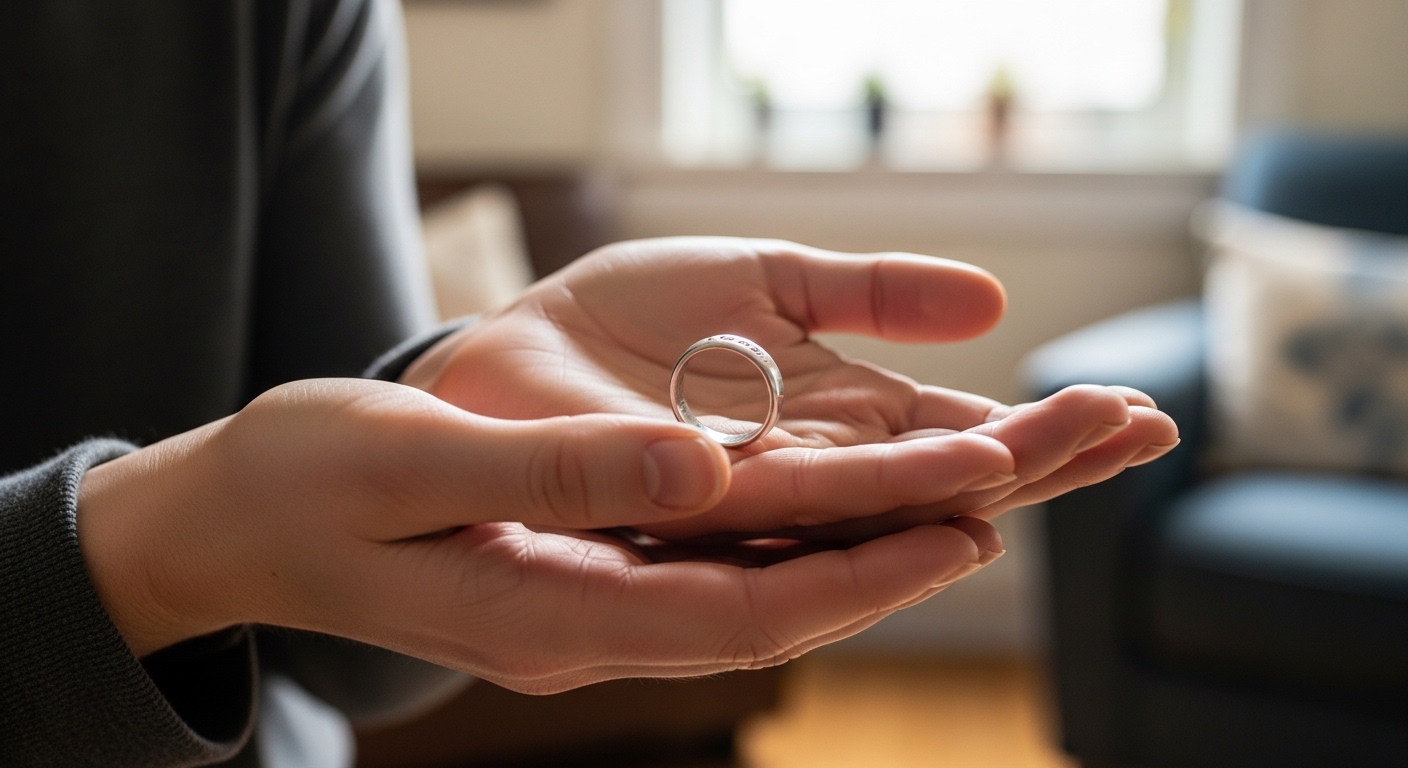
When the meal ended, Isla did something that would haunt me. She pulled a thin, tarnished ring from her finger and pressed it into my palm. It looked like vintage costume jewelry of negligible value, but to her, it was the sum of her worldly possessions. “Keep it,” she whispered, “so you remember you were kind.” I accepted it as a sacred trust, eventually threading it onto a chain beneath my shirt.
A year passed, marked by the typical financial struggles of the working class. One Saturday, while passing a local boutique specializing in high-end jewelry repair, a sign for free ring cleaning caught my eye. I walked in, expecting the jeweler to confirm the piece was a simple alloy. Instead, the man—a master gemologist—took the ring under his lamp and his hands began to shake.
With a voice thick with grief, he told me he had crafted this exact ring for his daughter on her eighteenth birthday. He had buried her with it eight years prior. The revelation turned the shop into a theater of the impossible. I told him about Isla. The jeweler sat down heavily, tears blurring his vision. He explained that his daughter had died shortly after giving birth. The child, his granddaughter, had been lost in the foster care system before the family could secure guardianship. He had spent nearly two decades searching for a ghost. He begged me to find her.
Finding someone without a permanent address is a Herculean task, but two months later, the universe corrected itself. During a shift at a local non-profit center, the door swung open to reveal Isla. She was older, her face etched with the resilience of motherhood, carrying a baby boy named Callum.
When I told her the truth, the room held its breath. I spoke of the grandfather who had never stopped searching. Isla, who believed she was an unwanted byproduct of a broken system, realized she was actually the most precious lost asset of a grieving family. I called the jeweler, and within thirty minutes, three generations of a fractured family stood in the same room.
The meeting was a masterclass in emotional healing. The grandfather offered her more than just a room; he offered her a legacy of belonging and a bridge to a new life. This experience redefined my understanding of philanthropy. We often think changing the world requires massive capital, but it’s often secondary to the radical empathy of a single person showing up at the right moment.
Today, Isla and Callum are thriving. I still work my shifts, but I carry a different kind of wealth. I’ve learned that small-scale kindness is a high-yield investment. We can’t fix the global housing crisis overnight, but we can offer a coat to a shivering girl. We can keep a “cheap-looking ring” until it finds its way home. When we choose to see the person instead of the problem, we open the door for miracles. Isla wasn’t just a statistic; she was a granddaughter waiting to be found. And all it took was a simple, low-cost act of mercy on a cold winter night. That is the true return on investment for a life lived with an open heart.