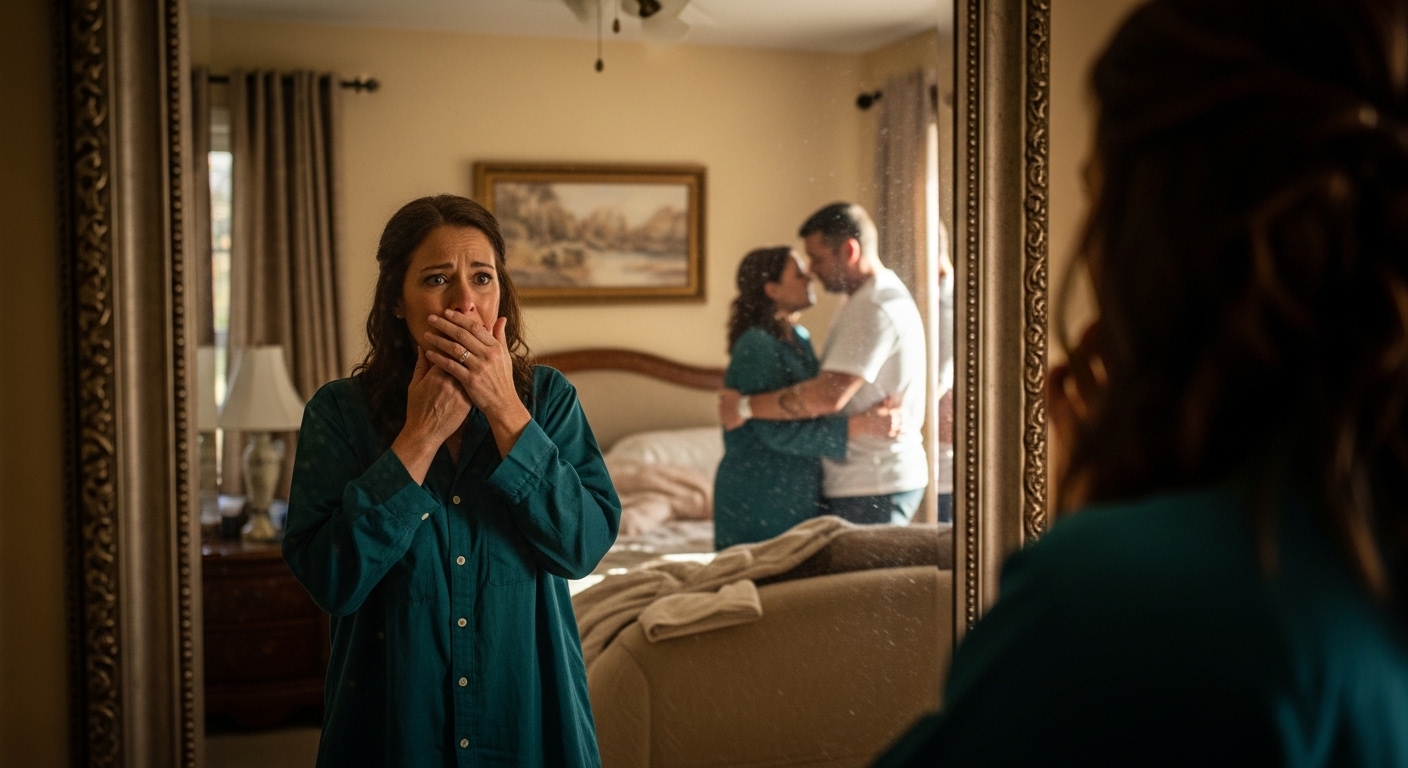
Returning home early from work is usually a pleasant surprise, but for one woman, it turned into a living nightmare. As she stepped through the door, the familiar sound of laughter echoed through the hallway—a sound that should have been comforting but instead felt strangely out of place. Following the noise, she caught a glimpse into the bathroom mirror, and her heart stopped.
There, reflected in the glass, was a sight that shattered her world: her husband, seemingly locked in an intimate embrace, kissing her sister.
The shock was instantaneous and agonizing. Fueled by a cocktail of fury and heartbreak, she burst into the room to confront them. She was prepared for a tearful confession or a defensive argument, but instead, she found only her husband. He stood there alone, looking utterly bewildered by her sudden, tearful rage. She scanned the house frantically, searching closets and spare rooms, certain her sister was hiding nearby. Yet, the house was empty.
Her husband stood his ground, his confusion genuine. He insisted with growing concern that nothing had happened—that he had been alone the entire time.
As the adrenaline began to fade, replaced by a haunting confusion, the woman returned to the spot where she saw the reflection. She began to reconstruct the scene, searching for the logic in her trauma. Slowly, the chilling truth crystallized. The mirror had not captured a moment of current betrayal, but rather a deceptive fragment of an earlier, innocent interaction.
Earlier that afternoon, her sister had indeed been over, standing closely behind her husband while they shared a joke. From the specific, slanted angle of the doorway, the mirror had compressed the space between them. What was actually two people standing near each other in laughter appeared, through the silvered glass, as a romantic embrace.
Later that evening, her sister confirmed she had departed long before the wife arrived home. The realization hit like a physical blow. She hadn’t witnessed an affair; she had witnessed a perspective trick.
Shaken to her core, the woman wasn’t reeling from a broken marriage, but from the terrifying realization of how fragile trust can be. She had been ready to end her life as she knew it based on a literal trick of the light. It serves as a haunting reminder for all: sometimes what looks like the absolute truth is merely a distorted reflection. In the end, deep-seated doubt can be far more destructive to a relationship than betrayal itself.