“THAT BANK CLOSED BACK IN THE EIGHTIES,” my father scoffed when my grandfather handed me the old passbook at my wedding, yet I went anyway, and the manager later stepped out from behind the teller counter with another executive beside him, both of them suddenly much more formal than anyone ever becomes over something as small as a worn, outdated bankbook.
It was just after nine on a quiet morning in Denver, with the pale sky stretching over the distant mountains while downtown office buildings slowly came to life behind glass facades, and I stood there in dusty work boots and a faded flannel shirt, holding the same blue passbook my grandfather had pressed into my hands years earlier while most of my family dismissed it as a meaningless relic from a past that no longer mattered.
My grandfather, Harold Whitaker, gave it to me near the end of my wedding reception, when the band had shifted into slower songs and the barn venue outside the city glowed under warm string lights while guests settled into that soft, tired happiness that follows a long celebration.
He wore a navy suit I had never seen before, one that looked carefully preserved, and my wife later told me it seemed like something he had been saving for an occasion that truly mattered to him.
“For your future,” he said quietly, holding the passbook for a moment before placing it into my hands, “keep it safe, not for now, for later when it matters.”
I looked down at the cover, which read First Mountain Savings and Loan in faded letters, with corners worn smooth from decades of use, and inside the pages held handwritten entries beginning in the early nineteen seventies in careful, steady script.
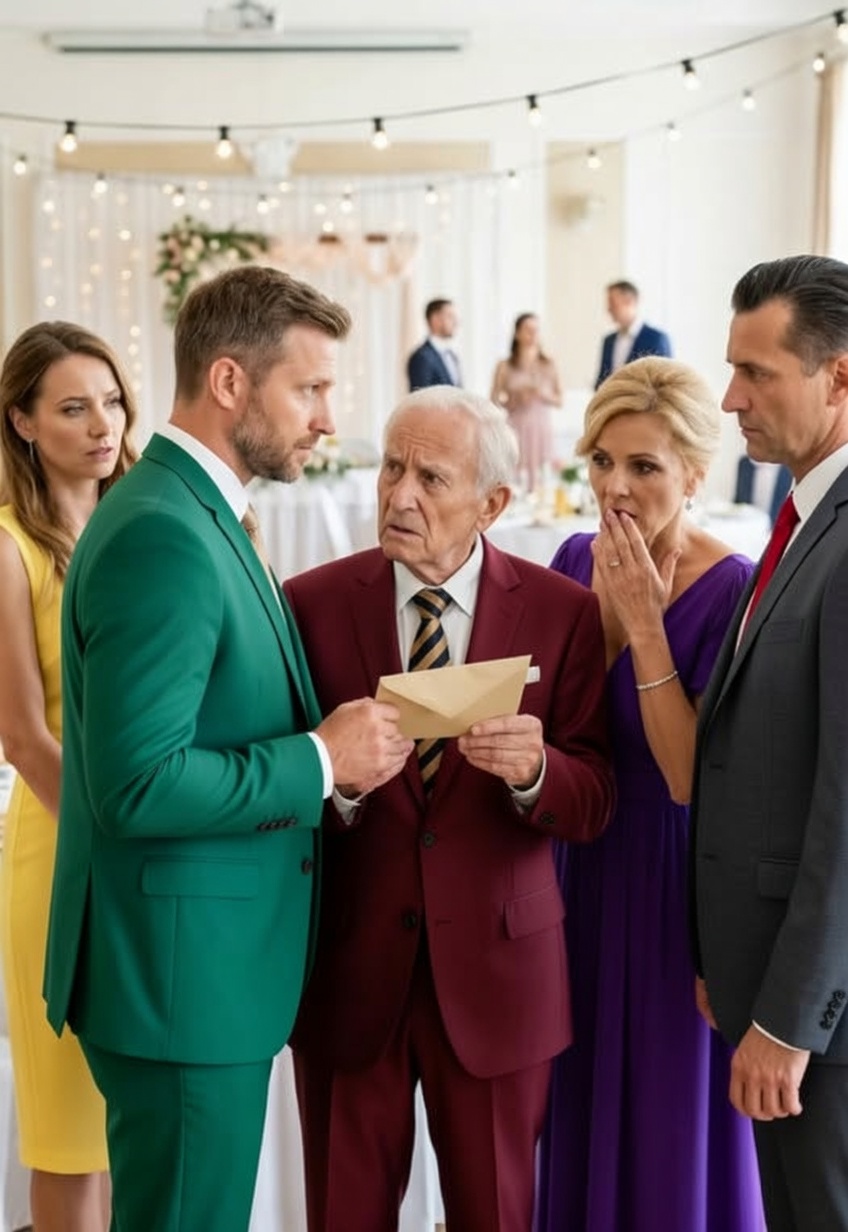
Before I could ask anything, my father, Ronald, stepped beside me, took the passbook from my hands, and opened it with a short laugh that carried just enough ridicule to make everyone nearby glance over.
“What is this supposed to be,” he said, flipping through the pages, “that bank shut down in the eighties, Dad, this is worthless.”
My mother, Denise, approached with her glass still in hand, smiling politely in the way people do when they want to smooth over discomfort without truly respecting it.
“Oh Harold,” she said lightly, “couldn’t you have just written him a check like everyone else does for weddings.”
My older brother, Kyle, leaned in with that polished confidence he always carried and gave a quiet chuckle.
“There might be enough in there for a sandwich,” he said, clearly amused.
My sister, Megan Whitaker, barely glanced at the passbook before looking away, already uninterested.
Grandpa Harold did not argue, he simply looked at me with calm certainty and said, “You keep it, Lucas, and when the time comes, you will understand exactly what it means.”
There was no anger in his voice, no defensiveness, only quiet confidence that felt out of place in that moment.
I caught the passbook when my father tossed it back toward me and slipped it into my jacket pocket, and I wish I could say I went to the bank right away, but I did not because life has a way of filling every empty space before you realize what you are putting off.
Work started early and stretched late into the evenings, my wife Emily became pregnant not long after, our son was born, and bills rose and fell in cycles that always seemed to demand attention first, leaving little room for anything uncertain.
The passbook stayed in my nightstand drawer beneath spare keys, old receipts, and a watch I only wore on rare occasions, and over time it became something I thought about less often, though never completely forgot.
What I never stopped doing was visiting my grandfather every Sunday, because for twelve years those visits became the one constant in my life that nothing else ever replaced.
We sat on his porch in the summer with cold lemonade, inside at his kitchen table in the winter with strong coffee, and we talked about everything from work to family to the small details of everyday life that most people overlook.
“You keep things working,” he told me once, watching me describe a long day on a job site, “do not let anyone ever make that sound small, because the world depends on people who fix what breaks.”
He lived in the same modest house on the east side of Denver for decades, drove the same old truck for years, and wore clothes that seemed unchanged by time, and nothing about him ever suggested wealth of any kind.
Then he passed away in February, quietly in his sleep, leaving behind a silence that felt heavier than anything I had expected.
The funeral was small, attended mostly by neighbors and a few old coworkers who had known him when he worked at the mill, and the house afterward smelled faintly of wood and cleaning polish and absence.
My father checked his watch more than once during the service, my mother left early, my brother spent more time looking at his phone than anything else, and my sister seemed eager for it all to end.
I gave the eulogy because someone had to stand up and say what mattered.
“My grandfather did not live a life that impressed people who only value money and status,” I said, standing there with my voice steady, “but he lived a life that mattered in ways that cannot be measured by those things.”
Two days later, we sat in a lawyer’s office for the reading of the will, and the process was as uneventful as everyone expected it to be.
My father received the house.
My brother and sister split a modest savings account.
I was left with my grandfather’s old pickup truck and his toolbox, both things he had already given me before he passed.
“That sounds about right,” Kyle said with a smirk as we stood to leave, “and do not forget your antique bankbook.”
That sentence stayed with me longer than I expected, and the next morning, before leaving for work, I took the passbook out of the drawer and sat on the edge of the bed, holding it in my hands.
Emily woke up and looked at me with quiet concern.
“You have been staring at that for a while,” she said softly, “what are you thinking about.”
“I am going to the bank,” I replied, finally making the decision I had delayed for years.
“Today,” she asked, pushing herself up.
“If I wait any longer, I will never go,” I said, knowing that was the truth.
Downtown Denver still felt quiet when I arrived, and the bank itself felt like a different world, filled with glass walls, polished counters, and people dressed in ways that made me feel out of place the moment I stepped inside.
The teller, a young woman named Ashley, greeted me with a polite smile as I handed her the passbook.
“I am not sure if this account still exists,” I said, “it belonged to my grandfather.”
She nodded and began typing, her expression neutral at first, then slowly shifting as she paused, typed again, and looked at the screen with growing confusion.
“Sir,” she said quietly, “would you mind waiting just a moment.”
She disappeared into the back and returned with the branch manager and another man in a tailored suit who introduced himself as a regional director.
“Mr. Whitaker,” he said, sitting across from me, “there is no issue with your account, quite the opposite, in fact.”
He explained how the bank had been acquired multiple times over the years and how the account had remained active through each transition.
“Your grandfather made a deposit every single month for fifty two years without missing one,” he said.
“That cannot be right,” I replied, shaking my head as I tried to make sense of it.
“It is fully documented,” he said, turning the screen toward me so I could see the records for myself.
“Two hundred dollars every month, consistently, along with long term investments and compounded growth.”
I tried to do the math in my head, but the numbers did not seem real.
“The current balance is three million four hundred twelve thousand six hundred forty seven dollars and thirty one cents,” he said clearly.
The room felt like it shifted beneath me, and I had to grip the chair to steady myself.
“That is not possible,” I said, barely able to process the words.
“It is very real,” he replied gently, “and you are listed as the sole beneficiary.”
I do not remember leaving the bank, only that I ended up sitting in my truck for a long time, staring at the passbook in my hands while everything I thought I knew about my grandfather slowly rearranged itself.
Emily found me there and asked what had happened, and I handed her the paperwork without saying anything.
She read it once, then again, then sat down on the driveway as tears filled her eyes.
“Is this real,” she asked over and over.
“It is,” I said quietly, “all of it is real.”
A week later, my father called and demanded that I come to his house, and when I arrived, everyone was already there, waiting.
“Three million dollars,” he said immediately, his voice tight with anger, “and he left it all to you.”
“In what world is that fair,” my sister added, her tone sharp.
“In the world where I showed up,” I replied, meeting their eyes without hesitation.
My brother stepped forward, trying to sound confident.
“We can challenge this legally,” he said, “he was not thinking clearly.”
“Fifty two years of consistent decisions say otherwise,” I answered calmly.
Silence filled the room, heavy and unavoidable.
“You only care now because you know he had money,” I continued, “but when you thought he had nothing, none of you cared enough to even visit him.”
I walked out without waiting for a response, knowing there was nothing else to say.
Months later, the money remained invested, growing slowly and steadily just as my grandfather had intended, while we paid off our home, secured our son’s future, and kept our lives exactly as they were.
“You could stop working,” Emily said one evening as I came home tired from a long day.
“I know,” I replied, “but I do not want to, because this work matters to me.”
Every Sunday, I visit his grave with a glass of lemonade and sit there quietly, speaking to him as if he can still hear me.
“I understand now,” I tell him, “you were never poor, you were just living the life you chose.”
There was a letter waiting for me at the bank, written in his careful handwriting.
“You were the only one who saw me,” it said, “and that is why everything is yours.”
I still drive his old truck, still live in the same house, and still work the same job, because what he left me was never just money, it was the understanding of what truly matters in a life well lived.